Managing onsite cleaning supplies across multiple properties can be one of the toughest challenges for facility and property managers. Between balancing quality, storage, and sustainability, it’s easy for supply chains to get tangled — especially when several buildings or teams are involved.
Whether you manage offices, retail spaces, or business parks, having the right cleaning supplies in the right place at the right time is essential for consistency and efficiency.
Here are ten smart strategies to help you take control of your supply management, reduce waste, and keep every site running smoothly.
All-purpose cleaners for desks, glass, and surfaces
Disinfectants for high-touch points
Floor care products for linoleum, vinyl, and carpet
Restroom supplies (paper, soap, air fresheners)
Janitorial items such as mops, buckets, dusters, and microfiber cloths
Waste liners and dispensers
Having these essentials available at every site eliminates guesswork and helps teams stay consistent. The key is balance — enough inventory to meet demand, but not so much that products expire or clutter storage.
2. Match the Right Supplies to the Right Areas
Not all spaces are created equal, and neither are their cleaning needs. A modern office, a warehouse, and a retail front each require different products and procedures.
Here’s a breakdown of what works best:
Office areas: Light-duty surface cleaners, low-VOC disinfectants, and glass sprays.
Washrooms: High-strength sanitizers and odour-control products.
Lobbies and entryways: Industrial cleaning supplies such as neutral floor cleaners and polishers.
Breakrooms and kitchens: Degreasers and food-safe surface cleaners.
Storage and backrooms: Heavy-duty commercial cleaning supplies to remove soil and buildup.
Adapting supply types to each space prevents product misuse and maintains a professional standard throughout your facilities.
Use colour-coded bins for different areas (e.g., blue = office, red = restroom).
Store chemicals safely away from paper products and food-related supplies.
Rotate older stock to the front to prevent expiration.
For larger properties, digital inventory tracking tools help track use and alert you when supplies run low. A good cleaning supplies supplier can even integrate with your system for automatic replenishment.
4. Centralize Ordering Across All Locations
Ordering supplies independently for each site might seem convenient — but it’s rarely efficient. Centralizing purchasing helps you control product consistency, track spending, and negotiate better pricing.
When one person or department oversees supply ordering, you gain:
Bulk purchase discounts
Simplified vendor communication
Unified standards across every building
Less administrative time spent on individual orders
By consolidating your orders through a single cleaning supplies supplier, you’ll streamline costs and ensure that every facility uses the same trusted brands.
5. Quality Over Quantity
Cheap cleaning products often cost more in the long run. Lower-quality sprays, cloths, and mop heads require more frequent replacement and can reduce cleaning efficiency.
Invest in high-quality janitorial cleaning supplies that:
Use concentrated formulas (less waste per use)
Have ergonomic packaging for easier dilution
Are designed for commercial or industrial use
Last longer and perform consistently
While premium products may seem costlier upfront, they reduce labour hours, improve cleaning results, and extend surface life — saving money and effort over time.
Longer-lasting equipment due to gentler formulations
Examples of effective green products:
Enzyme-based carpet cleaners that digest organic stains naturally
Hydrogen peroxide disinfectants that break down safely into water and oxygen
Microfiber mop systems that reduce chemical use
Concentrated all-purpose cleaners with plant-based surfactants
When every site adopts these products, you demonstrate corporate responsibility while maintaining a healthier workplace.
7. Empower Your Onsite Staff
Even the best system fails if the people using it aren’t trained. Each facility should have one designated “supply lead” responsible for overseeing inventory, ensuring safe storage, and communicating reorder needs.
Provide training on:
Proper chemical handling and dilution
Storage safety (especially for concentrated products)
Recognizing product expiry and shelf-life indicators
Tracking and reporting usage
Empowered, well-trained teams ensure supplies are used efficiently, safely, and consistently — preventing misuse and unnecessary waste.
8. Partner with a Reliable Cleaning Supplies Supplier
A dependable cleaning supplies supplier is more than a product source — they’re your operational partner. They understand your cleaning programs, can anticipate your needs, and ensure consistent product quality.
Look for suppliers that offer:
Multi-location support for consolidated orders
Flexible delivery schedules for on-demand restocking
When your cleaning services provider also manages your on-site cleaning supplies, you benefit from:
Consistent product use across every site
Improved communication between cleaning crews and supply management
Reduced administrative time coordinating multiple vendors
One clear point of accountability for both service and product quality
One Partner. Total Peace of Mind.
Managing onsite cleaning supplies across multiple locations doesn’t have to be complicated. With the right systems, sustainable products, and a reliable partner, you can streamline purchasing, improve consistency, and support your environmental goals — all while reducing costs and downtime.
Metropolitan Building Maintenance offers exactly that: complete facility cleaning, supply management, and long-term reliability across the Lower Mainland.
Clean, well-maintained spaces are the backbone of professional business environments. Whether it’s a corporate office, healthcare facility, educational building, or industrial warehouse, the quality of your cleaning supplies directly affects appearance, hygiene, and occupant well-being.
At first glance, choosing janitorial supplies may seem straightforward—order what’s needed and restock as required. But for property managers and maintenance professionals, it’s far more strategic. The products you choose influence everything from cleaning efficiency and safety to equipment longevity and overall cost control.
High-quality commercial cleaning supplies make everyday maintenance faster, easier, and more effective. They reduce waste, limit exposure to harsh chemicals, and extend the lifespan of surfaces like floors, carpets, and countertops. In contrast, using inferior or mismatched products can lead to residue build-up, dull finishes, and even premature surface wear.
Beyond the aesthetic, cleaning supplies play a crucial role in workplace health. Proper disinfectants prevent illness transmission, microfiber systems trap allergens, and neutral pH cleaners protect delicate surfaces without leaving chemical traces in the air. For today’s businesses, maintaining a clean facility is not just about appearance—it’s part of a larger commitment to employee wellbeing and environmental responsibility.
That’s why facility managers across the Lower Mainland increasingly rely on trusted cleaning supplies suppliers who understand the balance between performance, sustainability, and budget.
In this guide, we’ll explore the types of supplies every facility should have, how to organize them efficiently, and why partnering with the right supplier makes all the difference.
The Core Categories of Cleaning Supplies Every Facility Needs
An effective maintenance program starts with having the right tools and products on hand. Every facility—large or small—depends on a foundational set of janitorial cleaning supplies designed to tackle daily cleaning challenges. Here’s a closer look at the main categories that keep commercial spaces running smoothly.
1.1 General Cleaners and Disinfectants
These are the workhorses of any cleaning routine. General-purpose cleaner cleaning supplies include everything from glass sprays to multipurpose detergents and sanitizing solutions. They remove dust, fingerprints, and surface grime, keeping office desks, breakroom counters, and glass partitions spotless.
All-Purpose Cleaners: Safe for daily use on most surfaces, ideal for desks, walls, and fixtures.
Disinfectants: Kill germs and viruses on high-touch points like doorknobs, elevator buttons, and countertops.
Glass Cleaners: Deliver streak-free clarity on windows, mirrors, and glass dividers.
Specialty Surface Cleaners: Designed for stainless steel, electronics, or other delicate finishes.
The right formulations improve cleaning efficiency while reducing chemical waste—especially when paired with microfiber tools that lift dirt more effectively than traditional cloths.
1.2 Floor Care Products
Floors are one of the most visible and heavily used areas in any commercial property, so maintaining them properly is essential. The type of flooring determines which cleaning supplies are required.
Common floor care categories include:
Neutral Cleaners: Safe for daily maintenance of VCT, linoleum, and sealed concrete.
Finish Removers (Strippers): Used periodically to remove old wax before refinishing.
Floor Finishes (Waxes): Add gloss and protection against scuffs and stains.
Auto-Scrubber Detergents: Low-foam formulations for machine use on large floor areas.
For facilities with hard flooring, using the correct chemical concentration protects both the surface and the equipment.
Restrooms and staff areas require specialized janitorial supplies designed to handle moisture, bacteria, and odour. These areas are among the most critical when it comes to maintaining occupant satisfaction—visitors notice immediately when they’re not properly maintained.
Essential restroom and breakroom supplies include:
Disinfectant sprays and foams for sinks, toilets, and fixtures
Non-acid bowl cleaners for porcelain and urinals
Air fresheners and odour neutralizers
Hand soaps, sanitizers, and paper products
Touch-free dispensers and waste receptacles
Choosing commercial cleaning supplies with antibacterial or eco-certified formulations improves hygiene while reducing environmental impact. And since restrooms are cleaned frequently, investing in quality consumables prevents excessive waste or dispenser malfunctions.
1.4 Paper Goods and Consumables
Every facility uses a steady stream of consumables—paper towels, toilet tissue, garbage liners, and hand soap refills. While these might seem routine, choosing the right products can significantly impact cost-efficiency and sustainability.
Smart selection tips:
Choose high-capacity rolls to reduce restocking frequency.
Select recycled or eco-certified paper products to support sustainability goals.
Match liner thickness to waste type (lighter bags for office waste, heavier for food areas).
Managing these items through on-site cleaning supplies storage ensures your janitorial team always has stock available without over-ordering or creating clutter.
1.5 Tools, Accessories, and Janitorial Items
Beyond chemicals and consumables, your cleaning staff needs durable, ergonomic tools to perform effectively. These janitorial items include everything from mop handles and wringers to microfiber cloths and safety signage.
Key janitorial tools:
Mops (string, flat, or microfiber) and buckets
Dust mops and sweepers for large surface areas
Extension poles and squeegees for window cleaning
Personal protective equipment (gloves, goggles, aprons)
Wet floor signs and caution cones for safety compliance
Having reliable, well-maintained tools improves productivity and safety, while poor-quality equipment increases strain and risk of injury. A professional cleaning supplies supplier can help standardize your toolkit to ensure every cleaner uses the most efficient products for their tasks.
1.6 Industrial and Specialty Cleaning Supplies
Some facilities require more specialized industrial cleaning supplies to address demanding conditions, like manufacturing, automotive, or food-service environments. These products are formulated to remove grease, oil, adhesives, and other contaminants that ordinary cleaners can’t handle.
Examples include:
Heavy-duty degreasers for machinery and shop floors
Absorbents for spill response
Solvent-based cleaners for adhesive removal
Industrial hand cleaners and sanitizing wipes
While powerful, these products require careful handling and proper PPE. The best suppliers will provide usage guidance and support to ensure safe and compliant application in industrial settings.
Tailoring Cleaning Supplies to Different Facility Areas
Every building has its own mix of high-traffic zones, delicate surfaces, and specialized spaces—and each demands a distinct approach to cleaning. Using the right commercial cleaning supplies for each area isn’t just about achieving the best appearance; it’s about protecting surfaces, ensuring safety, and maximizing efficiency.
2.1 Office and Lobby Areas: Presenting Professionalism
These spaces are the public face of your business. Clean, polished lobbies and work areas create strong first impressions for visitors and clients. They also influence employee comfort and productivity.
Recommended cleaning supplies:
Neutral multipurpose cleaners – for desks, walls, and fixtures.
Glass cleaners – for partitions, mirrors, and entrance doors.
Microfiber cloths and dusters – trap dust and allergens more effectively than cotton.
Spot carpet cleaners or encapsulation solutions – for quick cleanup of spills without leaving residue.
Furniture polish or stainless-steel cleaner – for high-visibility surfaces like metal trims and furniture legs.
When cleaning in office environments, choosing low-odour and VOC-free products is key. Strong chemical scents can linger and cause discomfort in enclosed spaces. Green-certified cleaners ensure your facility stays both fresh and occupant-friendly.
2.2 Restrooms: Hygiene and Consistency Above All
Restrooms are where cleanliness standards are most visible—and most scrutinized. A spotless restroom demonstrates professionalism and care, while neglected ones can undermine a company’s image in seconds.
Essential janitorial cleaning supplies for restrooms include:
Disinfectant sprays and foams for counters and sinks.
Non-acid bowl cleaners for toilets and urinals.
Tile and grout cleaners to prevent mould buildup in humid environments.
Air fresheners or odour control dispensers for continuous freshness.
Paper towels, tissue, and hand soap refills stocked in durable dispensers.
For deeper maintenance, periodic descaling or mineral removal products may be required—especially in facilities with hard water. The best cleaning supplies supplier will help you choose pH-appropriate products that clean effectively without damaging porcelain or fixtures.
2.3 Floors: Protecting One of Your Largest Investments
Floors endure the heaviest wear and are one of the most expensive surfaces to repair or replace. Maintaining them properly depends on choosing the right floor care cleaning supplies for your material type.
For hard-surface floors (VCT, linoleum, or sealed concrete):
Neutral floor cleaners – ideal for daily cleaning without dulling finishes.
Finish strippers – to remove built-up wax layers before re-coating.
Floor finishes (wax or polish) – for gloss and protection.
Auto-scrubber detergents – low-foam solutions for efficient machine cleaning.
For carpeted areas:
Encapsulation cleaners – dry quickly, lifting soil from fibres.
Deodorizers – maintain freshness between deep cleanings.
For best results, facility managers should schedule routine floor maintenance based on foot traffic and season. Winter conditions, for example, introduce moisture and salt that require stronger neutralizers to preserve floor finish.
2.4 Industrial Areas: Power, Performance, and Safety
Industrial environments call for industrial cleaning supplies designed to handle grease, oil, and other heavy contaminants. These areas often require products that meet both performance and safety standards.
Examples include:
Solvent-based degreasers for removing oil residue from machinery.
Absorbent pads and granules for spill control.
Non-slip floor cleaners that remove residue without increasing hazard risk.
Industrial hand soaps for removing grease without harsh abrasives.
Always store these supplies separately from general cleaning chemicals, and ensure proper ventilation when using industrial products. Many facilities maintain on-site cleaning supplies rooms in maintenance areas to ensure a quick response to spills and emergencies.
2.5 Windows and Glass: Clarity and Safety
Windows and glass partitions require products that clean without streaking or residue. In commercial buildings—especially multi-story office complexes—clean glass makes a clear difference in presentation and light quality.
Key supplies include:
Ammonia-free glass cleaners (safer for indoor use).
Squeegees and extension poles for reaching high glass.
Microfiber detailing cloths to polish frames and edges.
Professional-grade janitorial cleaning supplies for windows are formulated to cut through grease, fingerprints, and exterior grime without leaving film behind. For business parks or facilities with regular window maintenance, keeping these items in stock allows staff to handle light touch-ups between scheduled cleanings.
2.6 Kitchens and Breakrooms: Cleanliness Where It Counts
Breakrooms and shared kitchen spaces can quickly accumulate grease, crumbs, and odours. Using appropriate commercial cleaning supplies ensures these areas remain inviting and sanitary.
Essential supplies include:
Degreasers for counters, stoves, and microwaves.
Food-safe surface cleaners for tables and prep areas.
Dishwashing detergents and hand soap.
Odour neutralizers for trash bins and drains.
Kitchens are also a great place to use eco-friendly cleaners, as these reduce exposure to harsh chemicals in areas where food is present.
High-End vs. Budget Cleaning Supplies
Not all cleaning supplies perform the same, and understanding the difference between high-end and budget options can dramatically affect your cleaning outcomes, staff efficiency, and overall facility costs.
3.1 The True Cost of Low-Quality Supplies
Budget supplies often look attractive on paper—but their lower upfront cost can mask inefficiencies. Inexpensive products may require more frequent use or replacement, and can even damage surfaces or equipment over time.
Common drawbacks include:
Cheaper detergents often require more per application.
Streaking, residue, or dull finishes.
Mop heads, brushes, and pads wearing out quickly.
Harsh chemicals that erode floor finishes or discolour materials.
For property managers overseeing large portfolios, these small inefficiencies add up to significant long-term costs.
3.2 The Benefits of Higher-Quality Cleaning Supplies
Premium or professional-grade janitorial cleaning supplies may cost more upfront, but they offer better overall value through durability, performance, and reduced waste.
Advantages of investing in quality:
Concentrated products clean more effectively with fewer chemicals.
Predictable results, even across different surfaces.
Properly formulated products reduce wear on auto-scrubbers and carpet machines.
Low-toxicity formulas and ergonomic tools reduce risk.
A reliable cleaning supplies supplier can help you find the right balance between cost and performance—offering product tiers that fit your specific maintenance schedule, building type, and budget goals.
3.3 Evaluating Product Quality
To assess product quality, consider:
Concentration ratios: High-quality products are typically concentrated, reducing overall consumption.
Manufacturer certifications: Green Seal, EcoLogo, or ISO certifications indicate proven performance.
Compatibility: Ensure products are safe for your facility’s flooring, fixtures, and materials.
Staff feedback: The people using the supplies daily often spot performance differences first.
Partnering with a cleaning supplies supplier who offers trial programs or sample evaluations allows you to test new products without full-scale commitment—ensuring you’re investing in supplies that truly deliver.
The Rise of Green Cleaning and Sustainable Supplies
Sustainability has become a defining standard in modern building maintenance. Businesses no longer see green cleaning as a luxury or marketing choice—it’s an operational necessity that supports health, compliance, and corporate social responsibility.
A cleaning product is considered green or eco-friendly when it’s designed to minimize harm to human health and the environment while maintaining or exceeding the performance of traditional products.
Common attributes of green commercial cleaning products include:
Biodegradable ingredients: Break down naturally without polluting waterways.
Low or no VOCs (volatile organic compounds): Improve indoor air quality by reducing chemical vapours.
Reduced toxicity: Safe for both cleaning staff and building occupants.
Concentrated formulations: Require less packaging and reduce shipping emissions.
Sustainable packaging: Recyclable containers and refill systems.
These products are ideal for office spaces, schools, and commercial environments where air quality and occupant wellbeing are top priorities.
4.2 Certifications That Matter
When sourcing janitorial cleaning supplies, certifications can help you identify products that meet credible environmental standards. Look for labels such as:
Green Seal: Indicates the product meets rigorous environmental and performance standards.
EcoLogo (UL Environment): Certifies reduced environmental impact across a product’s lifecycle.
EPA Safer Choice: Ensures ingredients are safer for human health and the ecosystem.
LEED (Leadership in Energy and Environmental Design): Recognizes facilities that use sustainable products and practices.
A knowledgeable cleaning supplies supplier can help you identify which certifications best align with your building’s sustainability objectives or tenant requirements.
4.3 Examples of Eco-Friendly Cleaning Supplies
The market for green cleaning products has evolved rapidly—today’s options rival or outperform traditional chemicals in both effectiveness and safety.
Common examples include:
Plant-based degreasers: Use natural surfactants and solvents to break down oil and grease without harsh residues.
Biodegradable all-purpose cleaners: Ideal for desks, walls, and general surfaces.
Hydrogen-peroxide disinfectants: Offer powerful germ elimination without chlorine or quaternary compounds.
Microfiber mop systems: Reduce the need for excess chemicals by capturing dirt mechanically.
Using these products supports both occupant health and long-term sustainability initiatives. They also align with eco-conscious tenant expectations—an increasingly important factor in commercial leasing and facility management.
4.4 Why Green Cleaning Benefits Your Facility
Eco-friendly janitorial supplies go beyond environmental good intentions—they yield measurable operational benefits:
Improved indoor air quality: Low-VOC products reduce odours and airborne irritants.
Safer working conditions: Minimized exposure to toxic substances benefits cleaning staff.
Lower waste generation: Concentrated or refillable packaging reduces plastic use.
Reduced maintenance costs: Non-abrasive formulations extend floor and surface life.
Enhanced brand image: Demonstrates corporate responsibility to clients and tenants.
At Metropolitan Building Maintenance, we’ve seen firsthand how sustainable cleaning products support long-term building health and client satisfaction. Green cleaning isn’t just the future—it’s the smarter, more responsible choice for the present.
Safety, Storage, and Organization of Cleaning Supplies
Even the most effective cleaning supplies can create hazards if stored or handled improperly. Proper organization and safety practices protect staff, prevent contamination, and ensure that products are always accessible and ready for use.
A well-designed on-site cleaning supplies system not only streamlines workflows but also ensures compliance with safety regulations. For property managers, it’s an essential aspect of maintaining a professional and accountable cleaning operation.
5.1 Designing a Safe and Functional Supply Area
Whether your building has a single janitor’s closet or a full supply room, organization matters. Each area should be clean, ventilated, and clearly labelled to minimize risks.
Key setup recommendations:
Separate storage zones for chemicals, tools, paper goods, and PPE.
Proper ventilation to reduce chemical vapour buildup.
Chemical-resistant shelving and floors to prevent damage from leaks.
Adequate lighting and signage for easy identification and safe handling.
Lockable storage cabinets for potentially hazardous products.
For larger buildings, having on-site cleaning supplies storage on each floor or wing reduces staff travel time and ensures consistent readiness.
5.2 Safe Chemical Handling and Compliance
Most janitorial supplies include concentrated cleaning agents, so safe handling is essential. Training staff to follow manufacturer instructions prevents accidents, chemical reactions, and overuse.
Best practices for chemical safety include:
Label all containers clearly—never reuse bottles without relabelling.
Keep Safety Data Sheets (SDS) for all chemicals in a central binder or digital folder.
Never mix products (especially bleach and ammonia-based cleaners).
Wear appropriate PPE, including gloves, masks, and safety glasses.
Provide spill kits near chemical storage areas for emergency response.
A reliable cleaning supplies supplier can also provide SDS documentation and training guidance to help ensure your facility meets WorkSafeBC and national safety standards.
5.3 How to Organize Cleaning Supplies for Efficiency
Proper organization helps janitorial teams save time, prevent duplication, and maintain quality.
Tips for better organization:
Group products by task: Floor care, restroom, general cleaning, waste management, etc.
Use shelving and bins for small items like sponges, spray bottles, and pads.
Colour-code equipment: For example, blue cloths for glass, red for restrooms, green for general surfaces.
Rotate stock regularly: Use older products first to prevent expiry.
Keep inventory lists: Track what’s in stock, what’s low, and what’s unused.
Maintaining this level of organization also helps control costs. Facilities with well-managed on-site cleaning supply rooms tend to use less product overall and experience fewer shortages or emergency orders.
Track product usage and reorder points automatically.
Monitor costs and consumption trends by department or area.
Schedule deliveries based on actual usage instead of guesswork.
Integrating these tools ensures consistency and saves both administrative and operational time. It also reduces waste—an important step toward a more sustainable cleaning program.
The Importance of a Reliable Cleaning Supplies Supplier
A well-chosen cleaning supplies supplier can be the difference between a smooth, efficient operation and one that’s constantly struggling with shortages, inconsistent product quality, or unreliable service.
For property and facility managers, this relationship is not simply about sourcing products — it’s about partnership, expertise, and trust.
While many suppliers focus only on product delivery, the best ones act as long-term collaborators. They help you select the right commercial cleaning supplies for your surfaces and systems, recommend cost-effective substitutions, and ensure consistent availability of essential janitorial items.
6.1 Qualities of a Dependable Supplier
When choosing your supplier, look for these essential qualities:
The supplier should maintain reliable stock and timely deliveries.
They should understand commercial cleaning operations — not just retail cleaning.
A good supplier offers both industrial cleaning supplies and eco-friendly alternatives.
Quality suppliers provide guidance on product use, dilution, and safety.
A regional supplier ensures faster delivery, easier communication, and lower shipping costs.
A supplier who meets these criteria becomes a genuine extension of your team — not just a vendor.
6.2 The Cost of Unreliable Supply
Without a dependable supplier, maintenance teams may run into delayed deliveries, inconsistent inventory, or substandard substitutes. This can lead to:
Integrating Supply Management with Building Maintenance
In the commercial cleaning industry, true efficiency happens when janitorial supplies, labour, and maintenance operations work together as one system. Managing these elements separately can lead to miscommunication, redundant costs, and inconsistent quality. Integrating them simplifies procurement and strengthens accountability.
7.1 The Value of Consolidation
Instead of coordinating with multiple vendors — one for cleaning supplies, another for carpet cleaning, and yet another for window or floor care — property managers increasingly choose to consolidate services under a single provider.
A full-service company like Metropolitan Building Maintenance simplifies this process by offering both janitorial services and supply management. This ensures that the products being used match the standards and methods of the cleaning crews on-site.
Benefits of consolidation include:
Streamlined communication and billing
Fewer vendor contracts to manage
Consistent quality control across all cleaning operations
Optimized supply purchasing for better cost efficiency
Sustainable product selection aligned with your green cleaning goals
7.2 On-Site Supply Coordination
For multi-tenant buildings or large facilities, managing on-site cleaning supplies can be challenging without clear systems. When the same company handles both services and supply management, the result is a closed loop — products are stocked, tracked, and used efficiently by the same team.
This integration means:
Cleaning crews never run out of critical materials.
Product usage is monitored and optimized.
Waste and overordering are minimized.
All items remain compatible with the methods and equipment used on-site.
This model works particularly well in multi-floor office buildings, business parks, and commercial spaces throughout the Lower Mainland, where accessibility and timing are crucial.
7.3 The Role of Technology in Integration
Modern inventory systems and supplier management platforms allow service providers to monitor supply levels, automate reorders, and anticipate seasonal needs. When your janitorial cleaning supplies are managed through a unified digital system, your facility gains:
Real-time stock visibility
Automated low-stock alerts
Usage analytics by location or team
Simplified compliance reporting for sustainability
These efficiencies not only save money but also help demonstrate accountability and transparency — qualities that modern property managers highly value.
Supporting Facilities Across the Lower Mainland
When searching for cleaning supplies near me, it’s important to think beyond proximity — local expertise is just as valuable as local delivery.
Working with a supplier based in your own region means they understand the types of buildings, environmental conditions, and regulations unique to your area. For example, the Lower Mainland’s wet climate demands products that prevent mildew, salt buildup, and moisture-related surface damage.
Metropolitan Building Maintenance has been serving businesses across the Lower Mainland since 1980, supporting office complexes, retail spaces, business parks, and multi-story commercial properties.
Our experience means we know the materials, traffic patterns, and facility challenges that local property managers face — and we tailor our recommendations accordingly.
Local benefits include:
Faster on-site delivery and restocking
Responsive customer service
Knowledge of regional safety and environmental standards
Reduced transport emissions (supporting your green goals)
Local suppliers also contribute directly to community sustainability — supporting the regional economy while helping businesses achieve their environmental and operational objectives.
Consolidate for Quality, Sustainability, and Simplicity
When it comes to cleaning supplies for commercial facilities, the choices you make ripple through every part of your operation — from the quality of cleaning and staff efficiency to sustainability performance and cost management.
Maintaining a clean and safe commercial property requires more than just diligent janitorial staff — it starts with having the right products, consistently available and ready for use.
A reliable cleaning supplies supplier is the backbone of any effective facility management plan, ensuring your team has everything they need to maintain a professional environment.
In this guide, we’ll explore how to evaluate suppliers, select quality products, support sustainability, and ultimately simplify your office cleaning operations.
What Makes a Great Cleaning Supplies Supplier?
Not all suppliers are created equal. The right cleaning supplies supplier goes beyond providing products — they act as a partner in maintaining the facility’s standards. Here’s what to look for:
Comprehensive Inventory: From janitorial cleaning supplies like mops and microfiber cloths to industrial cleaning supplies for mechanical areas, your supplier should have everything on hand.
Product Knowledge & Training: Suppliers should guide your team on how to organize cleaning supplies, safe handling, and proper usage.
Reliable Logistics: Timely delivery of on-site cleaning supplies is essential, especially for multi-location facilities.
Transparency & Safety: Proper labelling, safety data sheets, and eco-certifications are signs of a professional supplier.
A strong supplier becomes a trusted partner, helping your property run efficiently and predictably.
Matching Supplies to Every Area of Your Facility
Different areas require different products. A top-tier cleaning supplies supplier will help you identify what works best for each zone:
Investing in higher-quality commercial cleaning supplies, like microfiber cloths, concentrated cleaners, and durable equipment, delivers better results and longevity. A knowledgeable cleaning supplies supplier can help you balance cost and quality, ensuring you get the best value for your budget.
Supporting Sustainability with Green Cleaning Supplies
Refillable spray systems and concentrated solutions
Top cleaning supplies suppliers offer these eco-friendly alternatives across their product lines, making it easy to integrate green cleaning into daily operations.
Proper storage is key: most janitorial supplies are kept in janitorial closets, with additional storage in unused rooms or cabinets. When space is limited, janitors should ensure vehicles are equipped to transport janitorial equipment safely.
A dependable supplier can track inventory levels, forecast needs, and restock before shortages occur — keeping your team prepared at all times.
The Local Advantage: Cleaning Supplies Near You
Working with a local cleaning supplies supplier near me offers several advantages:
Faster Delivery: Quick restocks of on-site cleaning supplies reduce downtime.
Personalized Support: Local suppliers often provide guidance, training, and product demonstrations.
Regional Expertise: They understand local building codes, sustainability standards, and facility requirements.
The ideal cleaning supplies supplier doesn’t stop at products — they provide a comprehensive service that supports your facility’s overall maintenance strategy.
Metropolitan Building Maintenance offers a full suite of services alongside high-quality janitorial supplies, including:
Choosing the right cleaning supplies supplier is about more than just purchasing products — it’s about building a partnership that supports quality, sustainability, and efficiency. From eco-friendly cleaners to on-site cleaning supplies and expert guidance on how to organize cleaning supplies, a reliable supplier ensures your facility always operates at its best.
With Metropolitan Building Maintenance, you get more than supplies — you gain a trusted partner who handles every aspect of commercial cleaning and maintenance.
In large buildings, keeping janitorial operations running smoothly depends on more than just good staff and schedules — it also depends on organization.
Knowing how to organize cleaning supplies properly can save hours of wasted time, reduce supply loss, and even prevent safety risks.
For property managers and facility teams, effective organization transforms cleaning from a reactive task into a proactive system.
Whether your facility uses in-house janitors or a contracted service, a well-thought-out supply management plan — backed by the right cleaning supplies supplier — makes all the difference.
Understanding the Full Range of Cleaning Supplies Your Facility Needs
Every large facility relies on a wide variety of janitorial supplies, ranging from basic tools to specialized products. Common categories include:
Janitorial cleaning supplies: Mops, buckets, microfiber cloths, and carts.
Industrial cleaning supplies: Degreasers, solvents, and heavy-duty floor cleaners used in mechanical or maintenance areas.
General janitorial items: Paper towels, liners, soaps, and dispensers for restrooms and breakrooms.
Cleaner cleaning supplies—those made with quality materials and reliable formulations—perform better, last longer, and reduce waste compared to cheaper alternatives.
Top Strategies for How to Organize Cleaning Supplies
When it comes to how to organize cleaning supplies, the goal is to make products accessible, clearly labeled, and safely stored. Here’s how to do it right:
Label and Categorize: Group janitorial items by function — for example, keep restroom cleaners separate from general-purpose sprays to avoid confusion or chemical mixing.
Centralized Storage with On-Site Access: Position on site cleaning supplies closets or cabinets near work zones to minimize travel time.
Use Appropriate Storage Areas: In most facilities, janitorial supplies are stored in dedicated janitorial closets, and to a lesser degree in storage rooms or unused closets. Where space is limited, janitors should ensure their vehicles are properly equipped and organized to transport janitorial equipment safely and efficiently.
Inventory Rotation: Keep track of usage rates, expiry dates, and reorder points to avoid stockouts or overordering.
Smart Storage Systems:
Locked cabinets for chemicals and sensitive materials.
Clearly labelled bins and shelving for easy access.
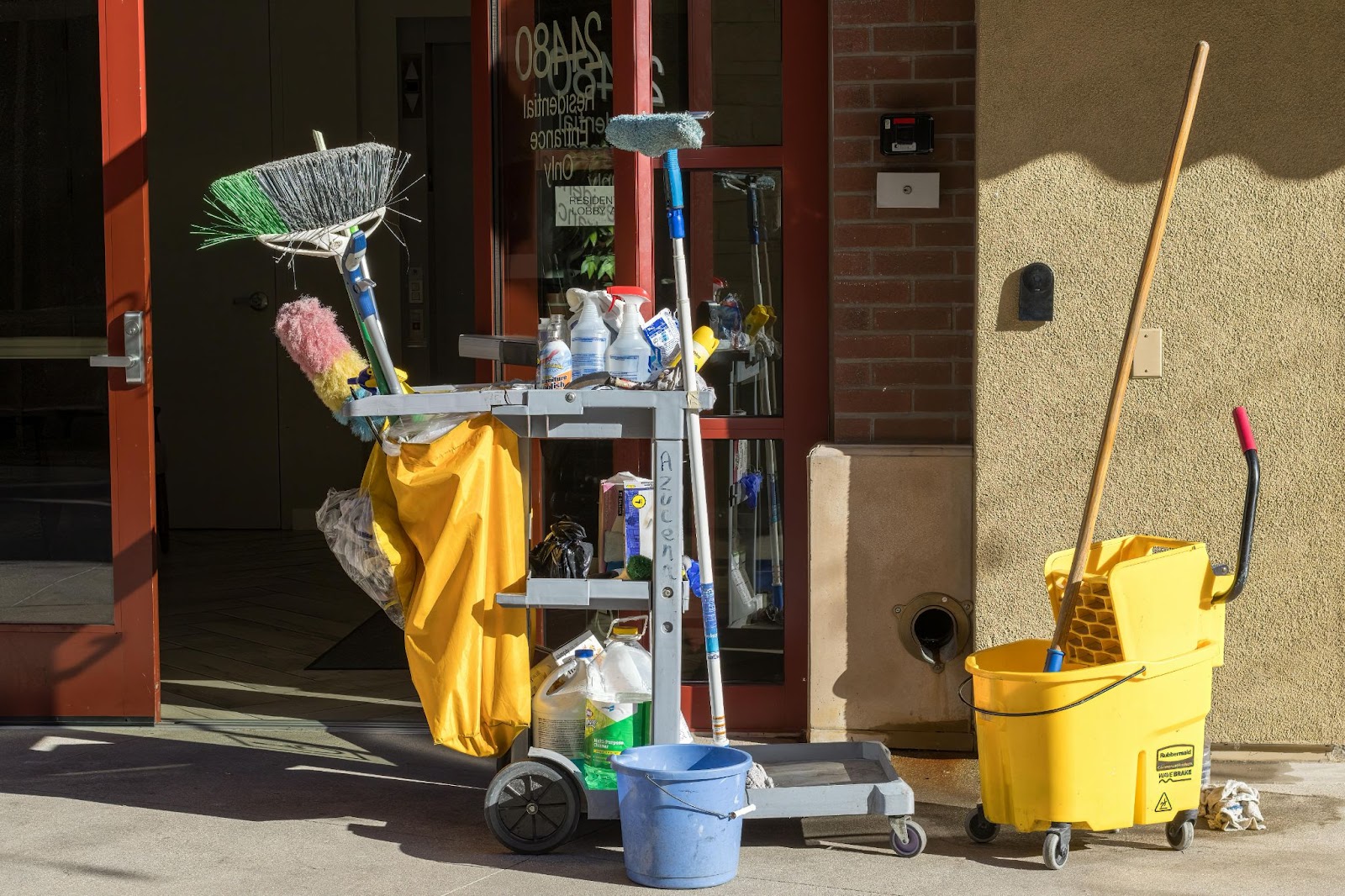
Rolling janitorial carts to transport cleaning supplies between floors.
Train Staff: Make sure janitorial staff are WHIMIS certified, know where supplies are stored, and what their needs are from zone to zone.
Proper organization ensures every cleaning shift starts prepared — not searching for missing tools or half-empty bottles.
Balancing Quality and Cost
Not all janitorial cleaning supplies are created equal. Low-cost products may seem attractive upfront, but they often lead to higher consumption rates and faster equipment wear.
Higher-quality options — such as concentrated cleaners, microfiber tools, and ergonomic carts — deliver better performance and durability.
Partnering with a trusted cleaning supplies supplier helps strike the right balance. An experienced supplier can recommend the best options for your specific facility, from commercial cleaning supplies to specialized products for sensitive areas.
Supporting Sustainability with Green Cleaning Products
Sustainability is no longer optional — it’s an essential part of responsible facility management.
Choosing green cleaning products not only supports environmental goals but also creates healthier spaces for staff and visitors.
Environmentally friendly cleaners are typically biodegradable, low in VOCs, and packaged in recyclable or refillable containers. These green cleaner cleaning supplies reduce chemical exposure while still providing professional-grade performance.
Many cleaning supplies suppliers now offer full lines of eco-certified options, making it easier to integrate sustainability into your operations without sacrificing results.
Why “Cleaning Supplies Near Me” Matters
Working with a local cleaning supplies supplier near you has several practical benefits:
Faster Delivery: Keep on site cleaning supplies replenished without long shipping delays.
Personalized Service: Local partners often provide customized product recommendations or training for janitorial teams.
Regional Expertise: They understand local facility needs, building codes, and sustainability standards.
At Metropolitan Building Maintenance, we go beyond supplies. We offer a full range of dependable services, including janitorial and carpet cleaning, floor care, and window cleaning — all supported by sustainable, eco-friendly practices.
When your cleaning supplies, services, and expertise come from one trusted source, your facility runs cleaner, greener, and more efficiently.
Maintaining a clean and organized office isn’t just about appearances – it’s about creating a healthy, productive environment for employees and visitors.
To achieve this, you’ll need the right cleaner cleaning supplies on hand.
But which janitorial cleaning supplies are essential for an office setting?
In this guide, we’ll break down the must-haves, from dust brooms to advanced floor machines, and provide tips on efficient organization.
Cleaner Supplies for Every Area of an Office
1. Office Area
The office area includes workstations, meeting rooms, reception areas, and common spaces.
Maintaining cleanliness here contributes to productivity and creates a positive impression on visitors.
Essential Cleaning Supplies:
All-Purpose Cleaners: For desks, tables, and shelves.
Glass Cleaner: Keep windows, mirrors, and glass partitions streak-free.
Microfiber Cloths: Ideal for dusting and wiping surfaces without leaving streaks or lint. Microfiber is highly effective at trapping dust and allergens.
Keep different colours for different tasks to avoid cross-contamination.
Disinfectant Sprays: Essential for sanitizing high-touch surfaces like keyboards, mice, door handles, and light switches.
Dust Brooms, Brooms and Dustpans: For smooth surfaces like VCT tile, concrete, or linoleum.
Vacuum Cleaners: The type depends on your flooring:
Upright Vacuums for carpets, with powerful suction and rotating brushes.
Backpack Vacuums for large offices, allowing quick movement and less fatigue.
Garbage Bags: A variety of sizes are needed for under desks, or larger central garbage bins.
2. Kitchen / Break Room
The kitchen or break room is a high-traffic area prone to spills, stains, and food-related messes.
Proper cleaning supplies help maintain hygiene and a pleasant atmosphere.
Essential Cleaning Supplies:
All-Purpose Cleaners: For countertops, tables, and appliance exteriors. Opt for food-safe options to ensure safety.
Dish Soap and Sponges: For washing dishes and cleaning sinks. Consider biodegradable sponges for an eco-friendly touch.
Disinfectant Sprays: Necessary for sanitizing countertops, microwave handles, refrigerator doors, and other shared appliances.
Glass Cleaner: For glass tabletops and appliance surfaces.
Mop and Bucket: Professional heavy-duty wet mop with a down-press mop wringer.
Floor Cleaner: Choose a degreasing floor cleaner for kitchen floors prone to spills.
Trash Cans and Garbage Bags: Heavy-duty garbage bags for food waste to prevent leaks and odours.
Paper Towels and Napkins: For quick cleanups and maintaining a tidy area.
Having a dedicated restroom cleaning kit simplifies the process.
Stocking the right cleaning supplies ensures cleanliness and reduces the spread of germs.
Essential Cleaning Supplies:
Restroom Cleaning Kit: Keep a dedicated kit for the washroom, including:
Caddy Organizer: A caddy keeps all supplies organized and easy to transport.
Toilet Bowl Cleaners and Brushes: Choose angled brushes for cleaning under rims. Use a powerful, eco-friendly toilet bowl cleaner to eliminate stains and odours.
Disinfectant Cleaners: For sinks, countertops, partitions, and door handles.
Glass Cleaner: For mirrors and reflective surfaces.
Air Fresheners: Automatic dispensers help maintain a fresh-smelling washroom.
Paper Products: Keep toilet paper, sanitary napkins, and paper towels in ample supply to prevent shortages.
Mop and Bucket: Professional heavy-duty wet mop with a down-press mop wringer. Ideally, you have a different mop for the bathroom floors.
Floor Cleaner: Choose a degreasing floor cleaner for kitchen floors prone to spills.
Garbage Bags: Durable garbage bags for restroom bins to maintain hygiene.
How to Organize Cleaning Supplies Efficiently
Knowing how to organize cleaning supplies helps your janitorial team work efficiently and safely.
Here are some organizational tips:
Designate a Storage Area: Choose a secure, easily accessible space like a janitorial closet.
Categorize Supplies: Group supplies by type – general cleaning, restroom, floor care, and trash management.
Label Everything: Clear labels allow for quick identification and prevent misuse.
Safety Precautions: Store hazardous chemicals separately from consumables and in well-ventilated areas.
Inventory System: Keep track of supplies to avoid shortages or overstocking.
Deep-Dive on Essential Janitorial Cleaning Supplies for Offices
When you’re standing in front of a row of 15 disinfectants or 12 all-purpose cleaners, it’s not always obvious what to buy.
The above lists by area help give insight into some of the basics, but what about green products, what about proper dilutions, storage, and labelling? And what are fair prices for on-site cleaning supplies?
Chemicals/Solutions/Cleaners
For most offices, you’ll only need 3-4 cleaning solutions: An all-purpose cleaner, a glass cleaner, a disinfectant, and possibly one for hard flooring.
It’s possible to get quality products that are either conventional or for green cleaning.
When selecting green cleaning products, look for certifications such as EPA Safer Choice or Green Seal, which indicate that the products meet stringent environmental and safety criteria.
Always follow the manufacturer's instructions for proper use and dilution to ensure effectiveness and safety.
It’s best to have trigger-spray heads and bottles on hand to be able to dilute the chemicals into the intended spray container.
In a lot of cases, all-purpose cleaners double as window cleaners. And often, there are disinfectants which are suitable for cleaning floors as well.
If you have no idea what to use, talk to the supplier, or order a couple of options and try them out to find what’s best.
Most cleaners today can be diluted quite a bit and remain effective, but always follow the stated ratios.
Finally, pricing for about 4 litres of a cleaning solution can be anywhere from $10 to $40 depending on the manufacturer, quality, and concentration.
Dusting Equipment
To maintain the cleanliness and air quality of an office dusting is a core necessity.
There are three levels of dusting and their frequency:
Everyday dusting–includes all visible areas at eye level when standing, like blinds, desks, chairs, computers, phones, etc., and can also include floors (if they are not being washed).
Monthly dusting–includes top of cupboards, wall-mounted items above head level like extinguishers or fire alarms, tops of partitions, and air vent grates.
Annual dusting (if necessary)–includes high ceiling elements like lights or exposed pipes, grates, wiring, or other areas which require telescopic poles or ladders.
For everyday dusting, microfibre clothes are best. Their ultra-fine fibres trap dust, dirt, and allergens. They are reusable, absorbent, and suitable for both dry dusting and wet cleaning.
Unlike traditional clothes, they don’t leave streaks or lint behind, making them perfect for glass, electronics, and other delicate surfaces.
Some types of blinds might need a feather duster to be cleaned properly, such as Venetian Blinds, but you might be able to get away with using a microfibre.
If you have large areas of hard flooring, then having a dust mop is ideal.
For higher surfaces you will need a telescopic pole, or if you have a detachable broom handle, that can work as well.
For the really high areas of an office with exposed 20-foot ceilings, you will need tall ladders or multiple-stage telescopic poles. It’s also important to have a robust type of feather duster that can hold a lot of layered dust.
For cleaning high areas that pile up, it’s also good to have eye protection and dust masks or a respirator.
Floor Care Supplies and Equipment
Although this is probably painfully obvious, there are two kinds of flooring: hard surface and carpet.
There are many types of hard flooring, such as VCT, linoleum, concrete, and terrazzo.
There are many types of carpets, such as nylon, polyester, acrylic, olefin, and wool.
Hard Surfaces:
For removal of dust on hard surfaces, it’s pretty easy, dust mops or wet mops.
It’s common for a quick-drying wax solution to be put down on any hard flooring that has regular traffic on it.
This protects the flooring from abrasion and wear and with enough wax regularly applied, it can extend the life of a floor for anywhere from 15-20 years or more (depending on the quality of the hard surface).
With repeated application of wax, there is inevitable build-up, and the wax itself can start to look bad.
There are lots of ways to maintain wax, including light of full stripping and re-waxing, burnishing, or regular deep cleaning.
The equipment for waxing is a mop and it’s usually good to have a garbage bag to tie around the mop head after use since wax mops are hard to clean and not good to use for other cleaning once they’ve been used for wax. You’ll also need your jug or container of wax to pour out as you move.
Doing light or full stripping and re-waxing or regular deep cleaning means you’ll need to have a floor machine (auto-scrubber) of some kind–ride standing or ride along. New, these machines are anywhere from $2000 to $10,000.
For burnishing, a special type of high-speed floor machine is used, and can also start around $2000.
Carpets:
For the removal of dust from carpets there’s vacuuming and hot-water extraction.
Vacuuming needs to be done regularly to be effective, and backpack vacuums are great for high-frequency and large layouts. For a deeper clean an upright vacuum with a beater bar is best.
For truly deep carpet cleaning, you’ll need portable units or a trunk mount. This is because carpet works like an air filter, trapping all airborne material into its fibres.
Vacuuming helps keep the levels at a minimum, but the only way to really remove a large percentage of the dirt from the fibres is to flush them with water and high-powered suction.
Upright vacuums can start around $500 and go to over $1000 pretty easily, and backpack vacuums are similar.
Carpet portables start around the $3000 mark and truck mounts are around $10,000 new and need to be built into a utility vehicle to be able to run, so altogether it’s probably upwards of $50,000. Best to call a company that owns these already.
Disposable Janitorial Supplies
It’s easy now to get green cleaning supplies that are good quality at any janitorial supply store, the only barrier is the cost.
Paper towels, toilet paper, garbage bags, and all cleaning solutions that are eco-friendly and green can be found.
Determining whether or not you can afford them is up to you, but the costs are getting more and more marginal.
When deciding on paper towels and toilet paper–items that get used often and need constant restocking–price might be a bigger factor.
For garbage bags, you can often get away with keeping the same bag in a given garbage bin as long as something wet or stinky isn’t thrown out. Often desk garbage is just dry material and can be dumped into a single large bag while doing rounds.
It might take a couple of months to determine your costing based on usage.
But one other really important part is quality. You and your staff will know if the quality of the toilet paper is not great and you will feel it quite literally every day.
There are lots of options for this kind of disposable supply, so make sure you figure out what’s both affordable but also pleasant to use.
Where to Find Quality Cleaning Supplies
To maintain a steady stock of cleaning essentials, it’s important to partner with a reliable cleaning supplies supplier.
Many offices benefit from buying commercial cleaning supplies in bulk, which is cost-effective and convenient.
If you’re searching for “cleaning supplies near me,” explore local janitorial stores or trusted online suppliers offering delivery options.